

Turn a Product Photo Into a Measurable In-Store Campaign
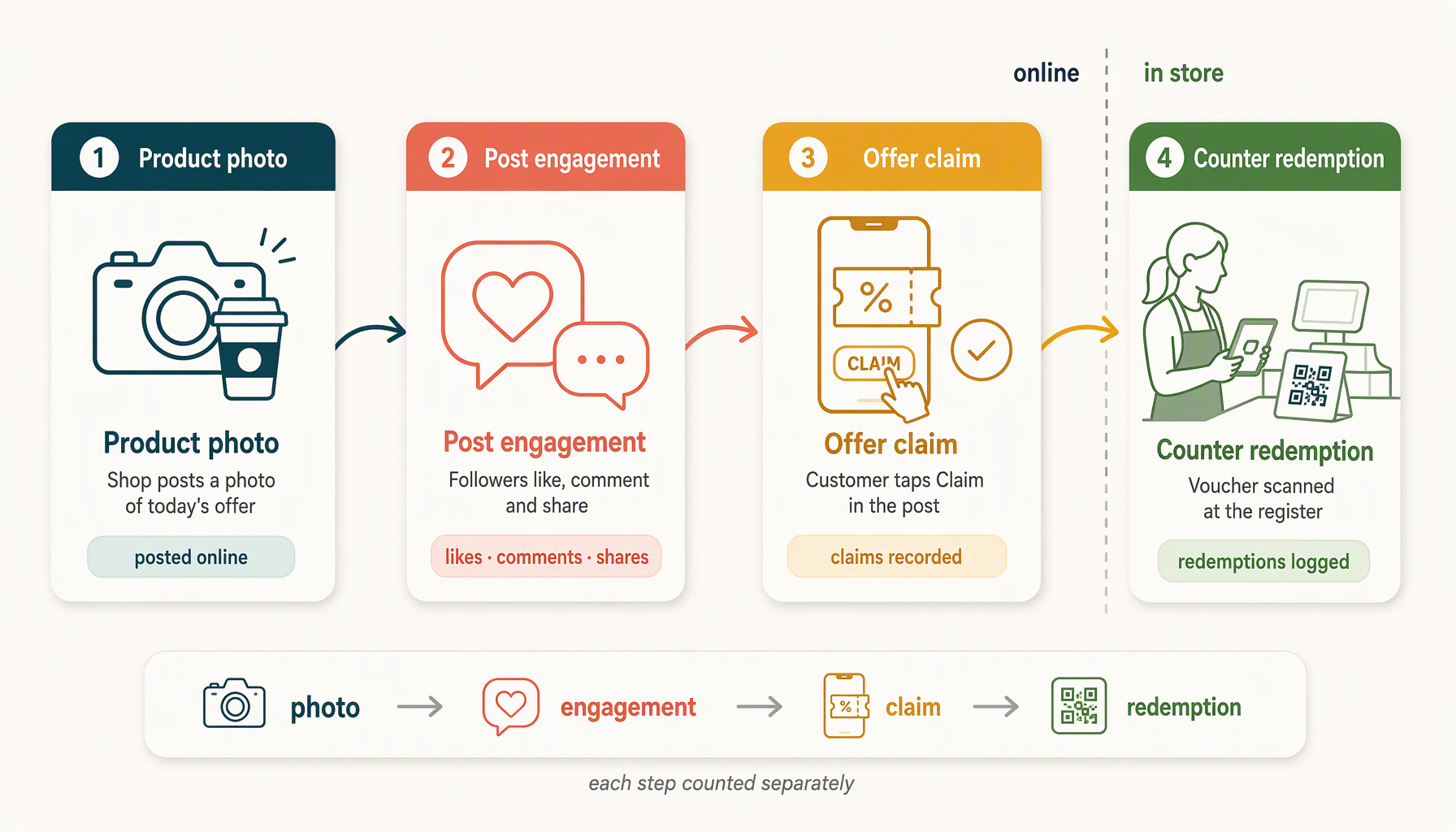
You post a photo of today's special. It gets likes. Someone says they'll come by. And then the week moves on, with no record of whether anyone actually did.
The gap is structural: social platforms measure attention, and your register measures sales, and nothing connects them. You can close that gap on a small-shop budget by giving every post a claimable next step and a redemption path you can count.
This playbook turns one product photo into a complete campaign: the post, the claim, the visit, the redemption, and the review.
Start with one item and one action
Pick a single product with two properties: it photographs well, and it has enough margin to carry a small offer. A seasonal drink, a fresh pastry line, or a signature item all work. Avoid bundling three products into one post; the goal is a clean line from post to purchase.
Decide the customer's next action before you design the image. Options in rough order of measurability:
- Claim a voucher tied to the item, redeemable at the counter. The claim is recorded, and so is the redemption.
- Save the offer to their wallet so it travels with the customer and can carry a reminder.
- Comment a keyword to receive the deal by direct message, which works on platforms that support it and depends on your automation being correctly set up.
- Show the post at the counter, the least measurable option, since you rely on staff memory.
Whichever you choose, the offer needs a defined benefit, a qualifying purchase, an expiry, and a redemption method. Write those four things before touching the caption. Our reward-cost worksheet keeps the benefit inside your margin.
Build the post around the offer, not around going viral
The photo should make the item unmistakable: good light, the actual product, and the setting customers will recognize when they walk in. Shoot it the morning you plan to post if possible; stock-style images read as advertising and perform worse for local audiences.
The caption carries the mechanics. A workable structure:
[The item, described in one appetizing line.] This week only: claim the offer in our bio and show it at the counter with any purchase. Ends [date].
Then check the mechanics against the customer's path. Does the link in bio go directly to the claim page? Does the claim page state the expiry and the qualifying purchase? Can a customer find the offer again two days later? Every extra step between the post and the counter loses people, and none of those losses show up in your like count.
If you use a comment-to-keyword flow, test it end to end with your own account before posting: comment the keyword, receive the message, open the offer, and check it renders correctly. Automated DM tools operate under platform rules that change; verify the connection works the day you post, and have the bio-link fallback ready.
Tell staff what is coming
A social campaign that the counter discovers by accident produces awkward moments: customers showing a phone to a confused employee, or worse, an offer honored inconsistently.
Before posting, give staff one card: the item, the offer, the expiry, the redemption step, and the exception rule. One minute of prep prevents a week of improvised decisions. If the offer requires scanning a wallet pass or entering a code, run one test redemption first.
Ask staff to note, in one place, what customers say about the offer. “The link was broken” and “people thought it applied to any size” are findings you will never see in the platform's analytics.
Read the full funnel, then act on the weakest link
After the campaign window, collect five numbers: post reach, offer claims, offers still unredeemed, counter redemptions, and any direct feedback. Platform analytics provides the first; your voucher or loyalty tooling provides the middle; your till and staff notes complete the picture.
The pattern tells you where to work next:
| Pattern | Likely issue | Fix first |
|---|---|---|
| High reach, low claims | Weak offer or buried mechanics | Sharpen the caption's action and make the claim one tap away |
| Good claims, low redemptions | Friction between claim and counter | Simplify redemption, extend expiry slightly, brief staff again |
| Redemptions, no repeat visits | One-time deal hunters | Add a progression step after redemption, e.g. a first stamp on the loyalty card |
For an illustrative example: a post reaches 1,200 local accounts, 45 people claim the voucher, and 12 redeem it at the counter. A 12-of-45 redemption proportion (about 27%) is neither good nor bad in isolation — what matters is the offer's cost (12 rewards) against the margin on those visits and what those customers do next.
One honest caveat: a redemption is a counted event, not proof of incremental profit. Some redeemers would have bought the item anyway. Over several campaigns, comparing claim-to-redemption behavior across different offers gives you a directional read on which incentives actually move your customers.
Make it a repeatable loop
Once one photo-to-redemption cycle works, repeat it with variations rather than reinventing it: the same structure, a different item, a different day, or a different offer type. Keep the measurement identical so results stay comparable.
Tools change the effort involved. Zea's social publishing workflow connects offers and copy to a posting calendar, and its voucher system records claims and redemptions, so the funnel above can live in one place. Setup, connected channels, and plan requirements vary, so verify the workflow with your own accounts before promising the loop to anyone else.
The follow-up matters as much as the post. Every redeemer should land somewhere: enrolled on the loyalty card, invited to come back for a second visit, or simply thanked. Attention you capture and then ignore is the most expensive kind.
Questions about social-to-store campaigns
How often should I run one?
Start with once every two to four weeks, enough to learn between campaigns without training customers to wait for a deal every week. Frequency can increase once redemption economics are proven.
Do I need paid promotion for this to work?
No. A modest organic reach with a well-built claim-and-redemption path can produce useful learning. Paid promotion amplifies whatever the funnel already does, so fix the funnel first, then consider boosting the version that worked.
What is the biggest mistake shops make?
Running the post without the counter being ready. The redemption experience is part of the campaign, and it is the part customers remember.
For the automation layer around campaigns like this, see five controls to set before automating your shop's marketing.