

A 14-Day Campaign to Turn First-Time Café Customers Into Regulars
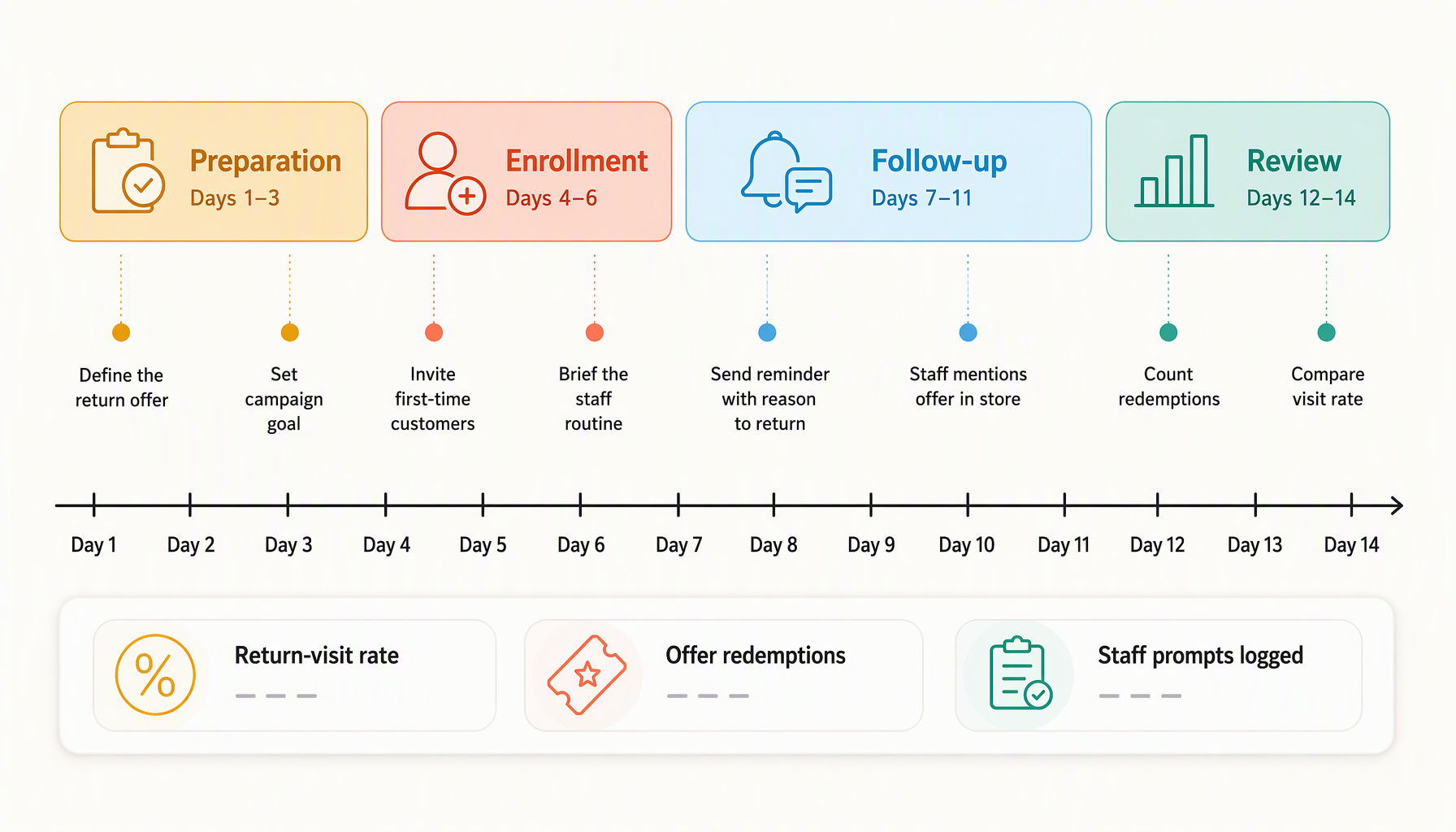
A 14-Day Campaign to Turn First-Time Café Customers Into Regulars
A first purchase tells you someone was willing to try your café. A second visit gives you another opportunity to become part of their routine.
You cannot guarantee that return with a loyalty card or a reminder. You can make the next visit easier to understand, give it a worthwhile reason, and remove friction at checkout.
This 14-day plan is a campaign structure to adapt, not a promised conversion window. Its purpose is to connect a first visit with a relevant next action and learn what helps your customers return.
Days 1–2: choose the reason to return
Start with the customer experience rather than the discount amount. Why should someone come back soon? The answer could be trying another product, progressing toward a reward, or using a modest welcome benefit on an eligible purchase.
Choose something you can afford to fulfill and explain in one sentence. A free add-on might fit one café; a fixed reward on a qualifying order might fit another. Calculate the reward using your actual costs before publishing it. Our reward-cost guide gives you a worked example.
Write down who qualifies, what they receive, what purchase is required, when the offer expires, and whether it can be combined with another promotion. Avoid setting conditions that staff will struggle to check during a busy shift.
Define the audience as first-time customers whose initial purchase you can identify. If you cannot distinguish a first purchase from the first time someone enrolled, label the audience as newly enrolled customers instead. Those groups are not necessarily the same.
Finally, decide what you want to record. Keep enrollment, first purchase, second purchase, and reward redemption as separate events. Someone may return without using the reward, and someone may join the program long after becoming a regular. Those distinctions make the final review more useful.
Days 3–7: introduce the campaign at checkout
Give staff one short invitation and a reliable process. The invitation should explain what the customer gets and what they need to do, without delaying the line or pressuring them to provide contact details.
For a hypothetical café offering a qualifying welcome benefit, the staff script could be:
“If you'd like to join our rewards program, you can scan this code. You'll see your welcome offer and the conditions for using it on a return visit.”
The customer should be able to review the terms before joining. Keep choices about marketing contact clear. A loyalty enrollment or a purchase should not be treated as permission for every possible communication channel.
Test the QR destination, enrollment, and reward process on a customer's phone before the first shift. Ask another staff member to run a test redemption using only the instructions you prepared. If they need the owner to interpret the offer, revise the reference card.
During the first few days, record problems in plain language: code hard to scan, offer not found, staff unsure which product qualifies. Resolve repeated problems before increasing enrollment effort.
An owner working remotely can still prepare the campaign, but a person in the shop must make the counter experience work. Assign one staff contact who checks the sign, explains the process to colleagues, and reports confusing customer questions.
Days 8–12: follow up where it makes sense
Review the customers who joined and have not made the relevant return purchase. Check that the offer is still usable and that the person is eligible for contact through the chosen channel.
A short reminder should help the customer use an existing benefit. For the hypothetical café, it might say:
“Your welcome offer is still available in your rewards account. Open it to see the expiry date and qualifying items, then show it when you order.”
Link to the actual offer rather than a generic homepage. Avoid artificial urgency: use the real expiry date and leave enough time for a reasonable visit. One relevant reminder is a better starting test than a series whose only change is a stronger subject line.
Remove customers from this follow-up when they complete the qualifying action, the offer expires, or they opt out. Check whether they recently received another campaign from your shop. The customer experiences all of your contact together, even if you manage email, wallet messages, and social content separately.
Zea's Smart Audiences includes a new-member, no-second-visit use case. Its usefulness depends on the underlying records and eligibility rules. Inspect those rules before applying them to this schedule; a suggested 14-day campaign is not a claim that every platform audience uses the same timing. Review the proposed audience and offer before launch.
Days 13–14: review a complete customer window
Write a brief review that compares the campaign's intention with the recorded activity. Count eligible customers, invitations or enrollments, qualifying return visits, redemptions, and the reward cost. Include staff time and the recurring questions that slowed the process.
Pay attention to when customers entered the campaign. Someone who joined on day 12 has had less time to return than someone who joined on day 3. Do not compare their response as though each had the same opportunity. Keep the final customer group open for its full offer window before treating the results as complete.
Suppose, in an illustrative example, 30 eligible customers joined and eight returned within their respective windows. The observed return proportion would be eight divided by 30, or about 27%. That is an example calculation, not a benchmark or proof that the campaign caused eight extra visits.
The review should end with a decision you can act on. You might keep the benefit but simplify the staff instructions, improve the explanation at enrollment, or allow a longer return window. If the offer attracted attention but customers could not use it, fix redemption before increasing the incentive.
Use the findings in the next campaign. Over time, your own customer behavior will be a more useful guide than borrowing an unexplained conversion target from another business.
Questions about second-visit campaigns
Does the reward need to be a discount?
No. A useful perk or progression toward an existing reward may be suitable. The benefit needs to be understandable, affordable, and relevant to the customer.
Can I run this without an email list?
You can introduce the campaign at checkout and provide a customer-accessible offer. Follow-up through a messaging channel depends on the contact information, permission, and delivery setup you have.
What if the customer returns after the campaign ends?
Record the return separately and apply the published offer conditions. Late activity can inform your next campaign without changing the original measurement window.
Explore Zea's customer engagement capabilities to connect your first-visit activity with the next campaign.