

How to Set a Loyalty Reward Your Coffee Shop Can Afford
How to Set a Loyalty Reward Your Coffee Shop Can Afford
The most common loyalty program mistake is not stinginess. It is setting a reward from a competitor's menu, or from a rule of thumb, without checking what it costs against your own numbers.
“Buy 8, get 1 free” can be generous or ruinous depending on your ticket size, your ingredient costs, and how many members complete the card. The same program that works for a busy café with a $9 average ticket may be much heavier for one selling $4 drip coffee.
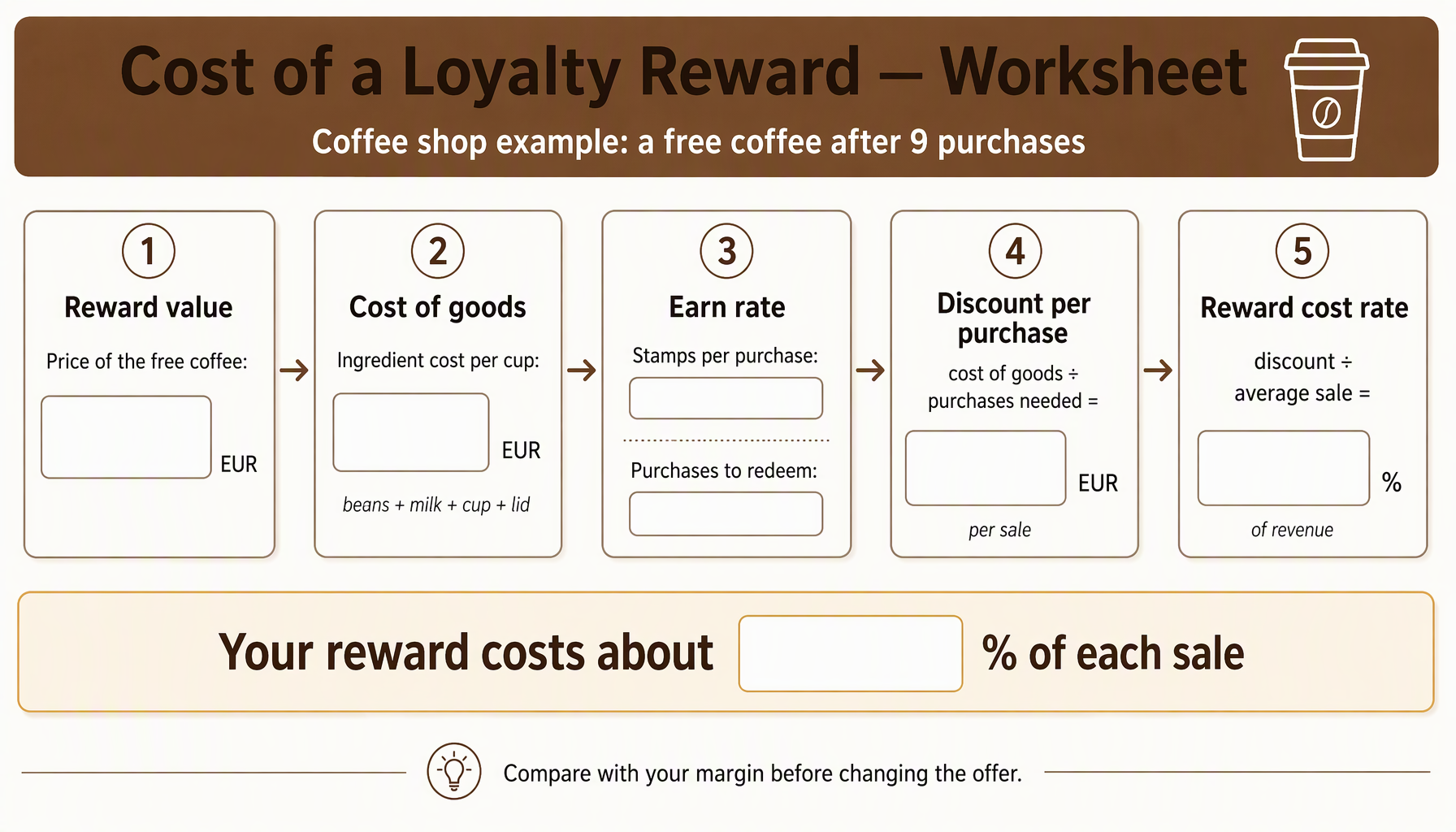
This worksheet takes about twenty minutes with your menu and last quarter's sales. The numbers below are a hypothetical example to show the method; use your own costs.
Step 1: calculate the reward's full cost
The cost of “one free coffee” is more than the coffee. Add the four components:
- Ingredient and packaging cost. What the item costs you to make, not its menu price. Suppose a 12 oz latte costs you $0.95 in milk, beans, cup, and lid.
- Upsize effect. Members may redeem on larger sizes or pricier items. Assume the redemption is your most expensive common interpretation unless your rules clearly limit it.
- Labor. Usually absorbed in normal service, but note any reward that adds preparation time at peak hours.
- Opportunity cost. A free item occasionally replaces an item the customer would have bought anyway.
For the example latte: ingredient and packaging $0.95, assume some redemptions upsize toward a $1.10 cost, labor negligible, opportunity cost conservatively $0.30. The working cost per redemption is about $1.40.
Step 2: estimate your completion rate
Completion rate is the share of enrolled members who actually reach the reward. Real-world rates vary widely, so use your own history when you have it. Before launch, reason from expected behavior:
- A tight requirement (8 visits in 30 days) produces fewer completions, each costing more in earned loyalty, and may frustrate casual customers.
- A loose requirement (5 stamps with no time limit) produces more completions, each spread over a longer period.
For planning, pick two scenarios: a cautious completion rate and an optimistic one. In the example café with 300 enrolled members, suppose 15% complete in the cautious case and 30% in the optimistic case. That is 45 to 90 reward redemptions per program cycle.
Step 3: total the program cost
Multiply completions by redemption cost.
| Scenario | Members | Completion rate | Redemptions | Cost each | Program cost |
|---|---|---|---|---|---|
| Cautious | 300 | 15% | 45 | $1.40 | $63 |
| Optimistic | 300 | 30% | 90 | $1.40 | $126 |
Divide by members to see the per-member cost: $0.21 to $0.42 per enrolled member per cycle. That is the number to compare against what the program does for you.
Step 4: set the earning rule to fit the margin
Now set the requirement so the cost per completed card matches a share of the incremental margin the program creates. A common framing: the reward should cost less than the margin you earn on the visits it took to earn it.
Suppose the average member ticket is $6.50 with roughly 70% gross margin, or $4.55 of contribution per visit. Over 8 visits that is $36.40 of contribution. A $1.40 redemption is under 4% of that. Even under the optimistic scenario, the program is arithmetically sustainable — provided the visits are genuinely additional, which is the honest uncertainty in every loyalty program.
If the same reward were attached to a $4.00 ticket with 55% margin, contribution per visit falls to $2.20, or $17.60 over 8 visits. The reward is still affordable at $1.40, but the cushion is thinner, and upsize behavior matters more. In that case, consider a smaller reward, a longer card, or redemption rules tied to specific items.
Rules that keep costs predictable:
- Define the reward precisely: “any 12 oz brewed coffee,” not “any drink.”
- State whether stamps expire, and pick a window customers can actually meet.
- Decide upsize handling before launch, and tell staff the rule.
- Cap any doubled-stamp promotions in advance, including which days they apply.
Step 5: plan the review, not just the launch
Pick a review point tied to your card length. For an 8-visit card, check results after the first full cycle, then quarterly. Record four numbers: members enrolled, cards completed, rewards redeemed, and reward cost. Divide cost by completed cards to check your working estimate against reality.
Then look at the behavior around the redemption. Do members who redeem return soon after and start a new card? Redemption followed by churn means the reward completed a transaction, not a habit. In that case, consider a small progress boost after redemption, or a next-card bonus that keeps momentum going.
Watch for two failure modes. If almost nobody completes the card, the requirement may be unreachable and the program is just a sign-up list. If nearly everyone completes it quickly, enjoy the engagement, then re-run the math, because your per-member cost is higher than the cautious case.
If you run rewards inside a platform like Zea, redemption tracking and wallet passes make the counts easier to pull, and paid plans add campaign controls on top. Features and limits vary by plan, so confirm what your chosen Zea plan includes before building the program around it.
A well-priced reward is one you would still be comfortable honoring on your busiest morning. If the answer is yes, the program can run long enough to tell you what it really does for the business.
Questions about reward costs
Should I offer a percentage discount instead of a free item?
Percentage discounts scale with ticket size and are easy to apply, but they are harder for customers to picture. A concrete reward (a specific free item) often motivates better at the same or lower cost, because its perceived value exceeds its cost to you.
How do I handle a reward I can no longer afford?
Honor the published terms for cards already in progress. Change the rules for new cards with clear notice, and consider a transition benefit for members near completion. Silent changes are what members remember.
Do bigger rewards create more visits?
Up to a point. Beyond the level where the reward feels meaningful, larger rewards mostly increase your cost per visit rather than the visit rate. Test a modest improvement before doubling the giveaway.
Use this worksheet with our second-visit campaign guide to connect a well-priced reward to a concrete campaign window.