

How a Customer Loyalty Loop Works: Shared Points, Referrals, and Repeat Visits
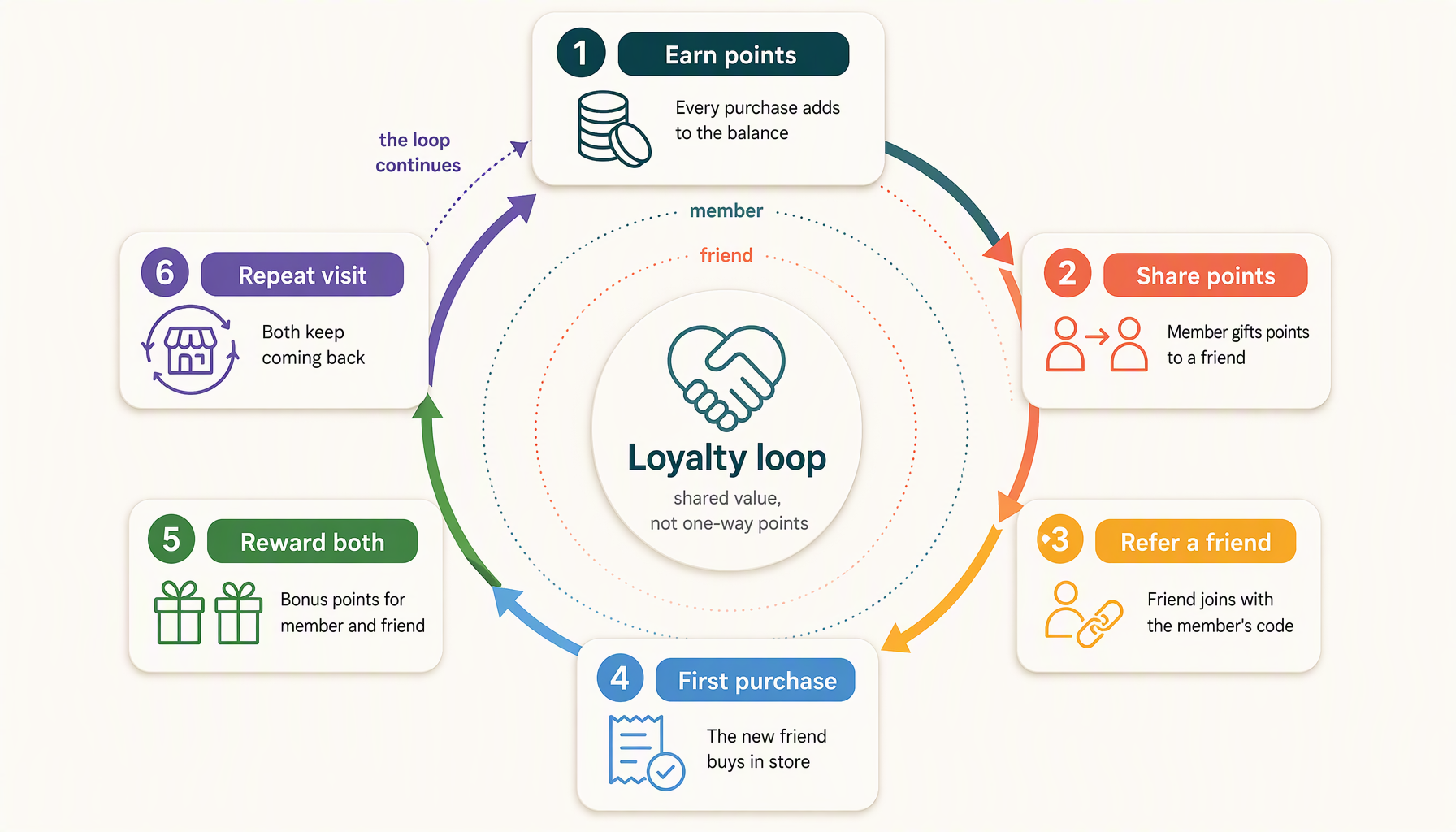
A loyalty program becomes more useful when the customer can do something with the value they have earned. They can save points toward a reward, share points with a relative who already belongs to the program, or invite someone new to visit the shop.
Those actions create different paths through the same customer relationship. Point sharing helps an existing member help someone close to them. A referral introduces the shop to a new person. A first purchase gives the shop a real event on which to award the configured referral benefits. The new member can then earn, return, share, and refer in their own turn.
That is a customer loyalty loop. It is a repeatable sequence of useful actions, not a promise that every customer will invite five friends. The shop creates the conditions: a benefit people understand, a simple way to share, a clear first purchase, and a reason to come back.
Separate point sharing from referring a new customer
These two features can sit next to each other in a loyalty program, but they solve different problems.
Point sharing moves existing value between members. A member can create a shareable request link for a loyalty card. A relative or friend who is already a member can open the link, choose an eligible card, and transfer some of their available points to the requester. The sender gives up points, and the receiving member gets them through a recorded transaction.
The point-sharing path can help a family use a reward together. One person may have points they will not use before they expire, while another member is close to a reward. A customer may also ask a relative to help them reach a reward for a shared visit or celebration. The shop does not need to create a separate account for every person involved, and the transfer remains visible in the loyalty history.
A referral introduces a person who does not yet belong to the shop's program. The existing member receives a campaign link or code. The invited person follows it, signs up, and makes a first points-earning purchase. The referral campaign can then award points to both people according to its configured rules.
Use plain language in the customer experience. “Share points with someone who already has a card” describes a transfer. “Invite a friend and earn points when they make their first purchase” describes a referral. Mixing the two creates disappointment: a member may expect an instant referral reward when the campaign waits for a first purchase, or expect to send points to someone who has not joined yet.
Build the loop around real customer moments
The best prompt depends on what just happened. A member who has earned a reward may be ready to share their experience. A member who is close to a reward may want to ask a family member for points. A member who has just returned after a long absence may be a good person to invite into a referral campaign later, after the experience is fresh.
Useful moments include:
- after a member earns enough points to understand the program;
- after a member redeems a reward and has a positive visit;
- when a member is close to a reward and has a trusted person who also shops with them;
- after a referred friend completes their first purchase;
- when a member has regular activity but has never used the referral option.
The prompt should name one action. A message asking customers to share points, refer a friend, redeem a voucher, and post on social media at the same time gives them too many decisions. Keep the other options available in the member experience, but choose the most relevant next step for the moment.
For example, a café might show a member their current point balance and a “request points” option when the member is close to a reward. After a successful referral, the café can show both the referrer and new member the points they received and the next reward they can work toward. The loop continues because the customer can see what their action produced.
Make point sharing understandable and safe
Point sharing needs clear ownership. The person who creates the request link receives the points. The other member chooses how many available points to send from an eligible card. The sender must have enough available balance, and the system should record both sides of the transfer.
Explain the important conditions before the sender confirms:
- which card the points come from;
- how many points will be transferred;
- who will receive them;
- whether the points carry an expiry date;
- whether the request link has a limit or expiry.
The customer should see a confirmation after the transfer. The receiver should see the incoming points in their history, and the sender should see the deduction. This record helps staff answer questions without guessing about a balance.
Point sharing should also respect program boundaries. A request link for one card should not silently move points from an unrelated program. If the shop runs multiple cards or locations, show the card name and the shop identity at every important step.
The feature works best as a way to help people who already trust one another. It should not become a reason to pressure customers into asking strangers for points. Keep the request optional, explain the value, and let members close or ignore a link they do not need.
Reward a referral after the first meaningful action
A referral link can create a signup, but signup alone does not show that the person became a customer. A stronger completion event is the new member's first points-earning transaction.
The flow is easy to explain:
- A member receives a personal referral link or code.
- They share it with a friend or relative.
- The new person opens the link and joins the program.
- The shop records the new person's first qualifying points-earning transaction.
- The campaign awards the configured points to the referrer and the new member.
The reward belongs to a campaign, so the shop decides the point amounts, cards, and eligibility rules. The referred person may receive a welcome bonus. The existing member may receive a referral bonus. State the trigger in the invitation and on the referral landing page. “You both earn points after your friend makes a first purchase” is clearer than “Invite friends for rewards.”
A first-purchase condition also gives the shop a way to protect its margin. The owner can define a minimum qualifying purchase, exclude staff or existing members where appropriate, and decide what happens if the first purchase is refunded. The rules should be visible before the customer shares the link.
Avoid turning the referral prompt into a permanent sales message. Show it after a useful moment, keep the share text short, and stop repeating it when the member has already sent several invitations. A member who receives the same referral request every week may stop engaging with every message, including the important ones.
Let rewards lead to the next relationship
The loop becomes valuable when each completion opens a sensible next step.
When a member receives shared points, show the reward they are now closer to earning. When a referred friend makes their first purchase, give them a clear reason to return. When the referrer receives their bonus, show the next reward or campaign that matches their history.
The same member record can support several forms of engagement:
- points create progress toward a reward;
- stamps record visits or qualifying actions;
- vouchers provide a defined offer with conditions and an expiry;
- referrals bring a new person into the program;
- social content gives members a reason to discover or share an offer;
- purchase activity tells the shop which follow-up is relevant.
The shop should still choose carefully. Someone who received shared points may need time to use them. Someone who just completed a referral may not need another discount. Someone who claimed a voucher but did not redeem it may need help finding the offer rather than a new incentive.
Zea connects these actions through the member and card records. Its referral workflow can create a personal code, attribute a signup, and complete the referral when the new member makes a first points-earning transaction. Its point-request flow records transfers between members. Rewards, stamps, vouchers, wallet passes, and campaigns can then give the member a clear next action, subject to the plan and configuration in use.
Measure the loop without calling it viral
Track the stages separately. A shop should know how many members saw the sharing option, created a point request, sent points, opened a referral link, signed up, made a first qualifying purchase, and received a campaign reward.
For an illustrative example, a café might have 100 active members in a month. Ten create a point request, six receive a transfer, and eight share a referral link. Three referred people sign up, and two complete a first purchase. Those figures describe one observed path through the loop. They do not establish a benchmark, and they do not prove that every reward caused an incremental visit.
Review the cost of the points awarded, the margin from qualifying purchases, and the return behavior of referred members. Also read the support questions. If members ask whether points can be transferred between cards, clarify the card rule. If referrals produce signups but no purchases, improve the first visit or the offer before increasing the referral reward.
The strongest signal is a healthy next action. A member requests points, reaches a reward, returns to use it, and later refers someone who becomes a customer. That sequence shows that the program gives customers reasons to help one another and reasons to come back.
Questions about shared points and referrals
Is sharing points the same as referring a friend?
No. Point sharing transfers existing points between members through a request link. A referral invites someone new to join, and the configured referral campaign can reward both people after the new member makes a qualifying first purchase.
Can a member share points with a relative?
Yes, when the relative is an eligible member and has available points to send. The request link and card rules determine which points can be transferred, how many can be sent, and whether the points keep an expiry date.
When should a shop ask for a referral?
Use a moment when the member has experienced value, such as after a reward, a satisfying visit, or a completed purchase. Explain the referral trigger and reward before asking them to share.
Should both people receive points immediately?
That depends on the campaign. A referral can be configured to award the referrer and the new member after the first qualifying points-earning purchase. The landing page and terms should state when each reward becomes available.
How do I prevent referrals from becoming spam?
Keep the share action optional, limit repeated prompts, set clear eligibility rules, and stop messages when the member has already acted. A referral program should make a genuine recommendation easier to share.
See Zea's referral and engagement capabilities, then compare the referral workflow guide with the reward-cost worksheet before setting the campaign rewards.