

Customers Claimed Your Offer but Never Used It. What Next?
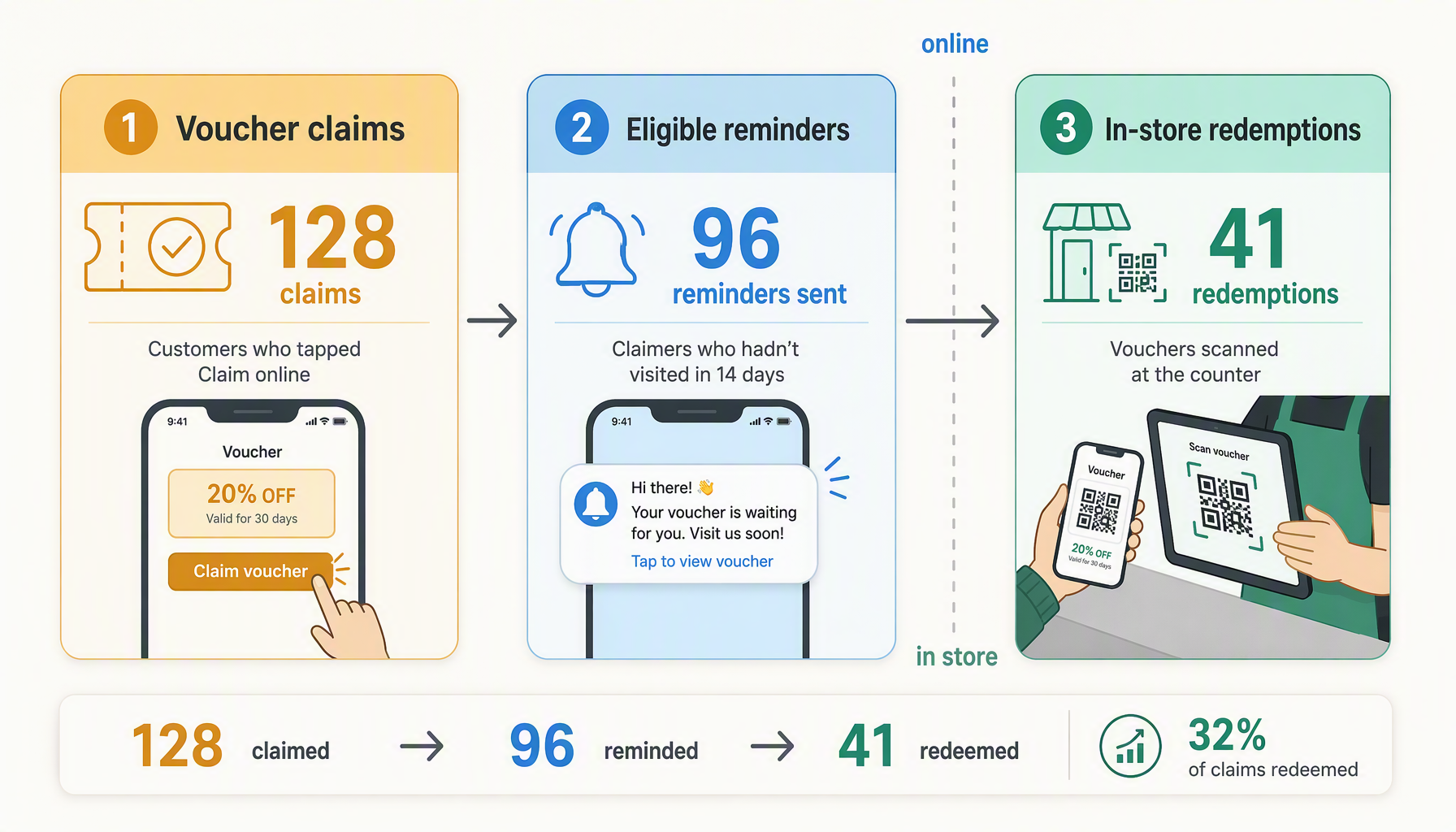
Customers Claimed Your Offer but Never Used It. What Next?
Your promotion received clicks. Customers claimed the offer. Then the shop saw fewer redemptions than you expected.
Before increasing the discount, check what happened between claiming and using it. The customer may have forgotten, misunderstood the conditions, struggled to find the voucher, or discovered that the timing did not fit.
An unredeemed-offer campaign starts with that gap. You identify eligible customers, remove practical obstacles, and provide a useful reminder when contact is appropriate.
Check whether the customer could use the offer
Open the offer from the original post or message and follow the same path as a customer. Read it on a phone. Check whether the customer can identify the product, location, expiry, and purchase conditions without searching another page.
Then inspect the return path. After claiming, can someone find the offer again? Do they need an account, a saved link, or a wallet pass? Does the message tell them what to show at checkout? A claim can be easy while redemption remains confusing.
Ask staff whether customers mentioned an offer they could not locate or use. Staff may have useful information that your campaign totals do not capture. One unclear exclusion can produce a series of awkward conversations and abandoned redemptions.
Also check whether the offer fits the people who claimed it. Someone outside your trading area may be interested in your content but unable to visit. A weekday-only offer may be unsuitable for customers who shop with you on weekends. These are audience and offer issues, not problems that another reminder necessarily solves.
If you discover incorrect conditions or a broken destination, fix the customer experience and handle affected customers fairly. Do not send more traffic into the same problem. Record the issue so the next promotion begins with a better test.
Build a useful follow-up audience
Separate people who clicked the promotion from people who claimed it. Then distinguish those who redeemed, those whose offer expired, and those whose offer remains available. Each status represents a different customer situation.
Your follow-up group should contain customers who still have an eligible offer and have not completed the qualifying redemption. Apply the appropriate contact permissions and exclude people who opted out. A claim alone does not establish permission to message them through any channel you choose.
Allow enough time for normal behavior. If the offer is valid for two weeks, sending a reminder immediately after the claim may be premature. If it is valid for one afternoon, a generic multi-day sequence makes no sense. Choose the window from the actual offer and the way customers visit your business.
Avoid building a permanent audience called “people who never redeem.” A customer's eligibility changes. They may redeem after the audience was prepared, receive an extension, or cancel their participation. Recheck the relevant status close to delivery where your system supports it.
Zea includes a Smart Audience for claimed, unredeemed vouchers. Review its timing and eligibility alongside your actual offer. The campaign still needs a working destination, an appropriate message, and a delivery channel you are entitled and configured to use.
Write a reminder that answers a practical question
A useful reminder explains what the customer can do now. Keep the offer, the conditions, and the redemption action consistent with the original promotion. Do not introduce a better discount just because someone has not acted yet; that makes the original campaign harder to evaluate.
Here is example copy for a shop with a still-valid offer stored in the customer's account:
“You still have an available offer in your rewards account. Open it to check the expiry and qualifying purchase, then show the voucher to our team before paying.”
In the published version, the linked offer should display the precise benefit and conditions. If the message format allows it, include the actual expiry date so customers do not need to guess how much time remains.
Give staff the same information. If a reminder increases visits, the team should know which campaign is active and how to handle someone who cannot open the voucher. Prepare a clear exception route without asking employees to improvise discounts.
Start with a restrained contact plan and inspect responses. If people redeem after the first reminder, suppress further reminders. If they ask the same question repeatedly, improve the offer page. A message that creates customer confusion needs a clearer explanation, not a more urgent headline or a higher sending frequency.
Measure redemption without overstating the result
Use a small set of separate measures: eligible claims, reminders attempted, messages delivered where available, qualifying redemptions, and offer cost. The denominator matters. A redemption rate among claimants is different from a redemption rate among delivered reminders.
For example, suppose a hypothetical shop records 40 eligible claims, 30 delivered reminders, and six later redemptions by those recipients. Six divided by 30 is a 20% observed redemption proportion among delivered reminders. It does not mean the reminder created six additional purchases. Some customers might have visited anyway.
Where practical, compare similar customers or use a comparable campaign without the reminder. Small samples, differences in purchase history, weather, and other promotions can limit the comparison. Explain those limits when sharing the result.
Include reward cost and owner effort in the review. If reminders lead to redemptions but staff spend too long resolving problems, simplify the workflow before expanding it. If customers cannot visit during the offer window, a different offer may help more than a different message.
Once someone redeems, move them into the appropriate next relationship. A first-time buyer may need a second-visit campaign. A regular may need no immediate follow-up. The next action should reflect what the person did, rather than keeping them in a sequence that no longer fits.
Questions about offer reminders
Should I extend every unused offer?
No. Review why customers could not use it and whether an extension makes commercial sense. Apply clear, consistent conditions rather than changing them unpredictably.
Is an offer claim the same as a sale?
No. A claim records interest or an entitlement to an offer. A sale or redemption is a separate event that needs its own record.
Should I send the reminder on every channel?
Start with an appropriate eligible channel and consider the customer's recent contact history. Sending the same offer everywhere can create more repetition than useful reach.
Review Zea's plans for campaigns and Smart Audiences to choose the setup that fits your offer-to-visit workflow.