

A Two-Week Marketing Calendar for a Busy Independent Shop
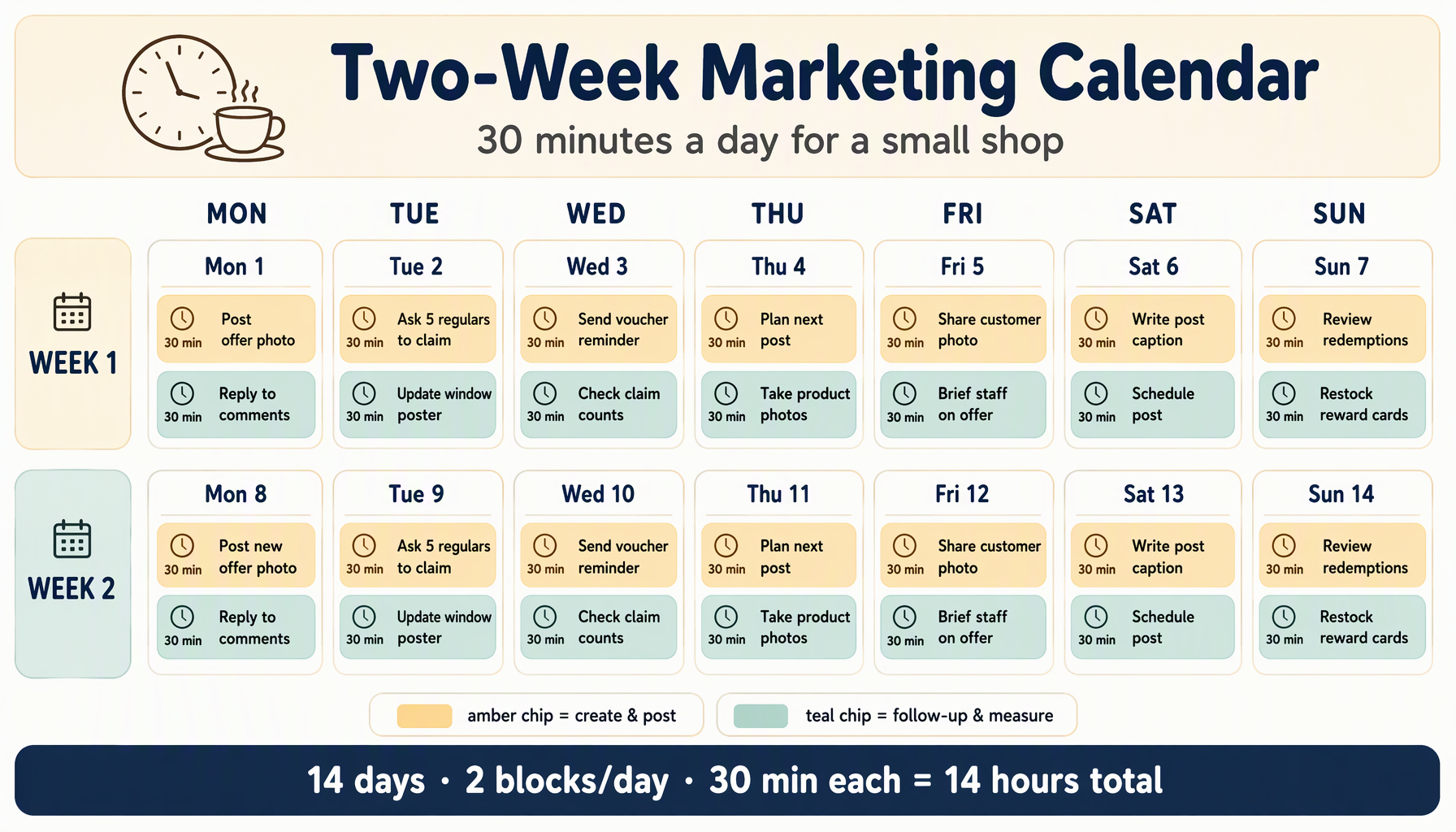
Most small-shop marketing plans fail on day three, when a staff member calls out and the social post nobody scheduled loses to the lunch rush.
The fix is not more discipline. It is a calendar small enough to survive a hard week: one campaign, a few supporting posts, and about thirty minutes a day. This template runs on that budget.
The shape of the two weeks
The two weeks carry one campaign from preparation to review. Everything else is a light supporting act.
| Week | Focus | Owner time per day |
|---|---|---|
| Week 1 | Prepare and launch one campaign | 25–35 minutes |
| Week 2 | Support, follow up, and review | 20–30 minutes |
One campaign means one audience, one offer, and one measurable customer action. If you also post product photos, local news, or team moments during the fortnight, treat those as ambient content — no offer, no tracking burden, no review.
Week 1: prepare and launch
Monday (30 min): choose the campaign. Pick the customer situation you can identify right now: new members who have not returned, unredeemed offers, or a seasonal item to push. Write one sentence: “We want [audience] to [action] by [date].” If you cannot name the audience from your records, that decision itself is the finding — start with a claimable offer instead.
Tuesday (30 min): build the offer. Set the benefit, the qualifying purchase, the expiry, and the redemption method. Run the numbers with our reward-cost worksheet so the offer is safe to honor at volume. Build the voucher or offer in your tooling today, not Thursday.
Wednesday (25 min): prepare the counter. Print or post the staff card: offer, conditions, redemption steps, exception rule. Run one test redemption. Confirm whoever opens tomorrow knows the campaign exists.
Thursday (30 min): create the launch content. One post announcing the offer, using the photo-caption-claim structure from our social-to-store playbook. Draft it, load the image, and schedule or post it. Keep the caption's action single and explicit.
Friday (20 min): launch and check. Publish. Within an hour of posting, walk the customer path yourself: see the post, reach the claim, open the offer, and confirm it reads correctly on a phone. Fix what is broken while traffic is arriving.
Weekend (10 min total): observe only. Note anything staff or customers mention. No changes yet; early panic adjustments muddy the read.
Week 2: support and follow up
Monday (25 min): first read. Check claims and redemptions so far. If claims are strong and redemptions are weak, ask staff what customers are saying. Small fixes (clearer expiry, simpler redemption) are worth making mid-flight; changing the offer itself mid-campaign muddies the review.
Tuesday (20 min): one supporting post. A reminder, a photo of the item in the wild, or a customer-friendly explanation of the offer's terms. Repetition helps honest customers who missed the first post; it does not require a new offer.
Wednesday (30 min): follow up where you have permission. If your campaign includes an eligible follow-up — for example, members who claimed but have not redeemed — send the single reminder now, mid-campaign, while the offer is still usable. Respect contact permissions and recent-message history; more channels is not more follow-up.
Thursday (20 min): prep the review. Export or write down the numbers you will need: reach, claims, redemptions, reward cost, staff notes. Doing this today makes Friday's review ten minutes instead of an hour.
Friday (30 min): review and decide. Compare the campaign's intention with its results, using the honest-measurement habits from our unredeemed-offer guide. End with one decision for the next cycle: repeat, adjust, or retire the offer. Write the decision down.
Weekend: off. A calendar you can actually keep includes rest. The fortnight restarts Monday with the decision you just recorded.
Rules that keep the calendar alive
One campaign per fortnight. Two concurrent campaigns double the admin and halve the clarity of every result.
Blocks are appointments. Thirty minutes at opening or closing, with a phone timer if needed. A skipped block rolls to the next day once; twice means the plan is too heavy, so cut the supporting posts, not the review.
The review never gets skipped. Even a bad fortnight produces a decision. The compounding value of this calendar is the record of what worked in your shop, not any single campaign.
Batch content creation. Shoot the week's photos in one session on Tuesday. Captions drafted in the same sitting take a quarter of the time of daily improvisation.
Templates carry the repetition. Keep your staff card, caption structure, and review sheet as files you copy each cycle. By the third fortnight, most blocks become edits rather than creation.
Adapting the template
Cafés and quick-service: the template fits as written. Peak-hour blocks belong at opening, before the first rush.
Salons and appointment businesses: shift the campaign toward bookings — the “claim” becomes a booking request, and the review counts completed appointments rather than counter redemptions.
Retail with variable footfall: anchor the campaign window to your busiest predictable days, and extend week 2's follow-up if your customers shop you monthly rather than weekly.
If your platform supports scheduling and automation, it can reduce the manual work in this calendar: scheduling posts, preparing a follow-up, or collecting a weekly summary. Zea's campaign calendar and Autopilot help organize this pattern, with limits you set. Automate only pieces you have run manually at least twice, and confirm delivery and plan availability in your own account before you depend on an unattended send. Read the guardrails worth setting first before you hand anything over.
The honest goal of this calendar is modest: after a month, you have run two campaigns, kept two review decisions, and stopped guessing about what your marketing does. That record is worth more than any single viral post.
When you are ready to run the calendar from one customer record rather than a collection of spreadsheets and reminders, review Zea's engagement tools and set up the first campaign only.
Questions about the calendar
What if I can only do three days a week?
Keep Monday (choose/prepare), Thursday (launch content), and Friday (review). The campaign just runs on a slower clock; the structure survives.
Can I run this with two campaigns a month of different lengths?
Eventually. Start with identical two-week cycles until the review habit is solid, then stagger a longer referral program alongside the short campaigns once the record-keeping is reliable.
Where do holidays and events fit?
Replace the standard campaign with the seasonal one in the relevant fortnight, and run the same review. Seasonal campaigns are not extra work on top of the calendar; they are the calendar's campaign for that period.