

Customer Engagement for Small Shops: Beyond the Loyalty Card
Customer Engagement for Small Shops: Beyond the Loyalty Card
A customer joins your rewards program, makes a purchase, and leaves. You now have a customer record and a reason for them to return. The next decision is yours: what should happen if they come back, stop visiting, claim an offer, or introduce a friend?
Customer engagement is the work of managing those next steps. For a small shop, that means connecting customer activity to useful messages, offers, and experiences without turning marketing into another full-time job.
A loyalty program can support that work. The wider opportunity is to use what happens in the program to decide what to do next.
Start with a customer action you can recognize
“Increase engagement” is difficult to turn into a task on a Tuesday morning. “Help people who claimed our offer use it before it expires” gives you an audience, an action, and a reason to follow up.
Choose a customer action that your shop can recognize. A first purchase, a second visit, a redeemed voucher, and a friend's qualifying purchase are different events. Each can justify a different campaign.
Consider a hypothetical café with customers in three situations. One person visited for the first time yesterday. Another usually comes on Fridays but has missed several Fridays. A third visits often and has never used the referral program. Sending all three the same discount ignores what you know about them.
The first customer may need a clear introduction to the program. The missing regular may appreciate a relevant reminder. The frequent customer may be a good fit for a referral invitation. None of those actions requires promising a discount to everyone.
Write your first campaign as a sentence: “We want this group to take this action within this period.” Then check whether you have the activity records and contact permissions to identify and reach that group. If those records are missing, improve enrollment and purchase recording before adding more campaign rules.
Connect the offer to what happens in the shop
An online campaign is incomplete when the customer cannot use it at the counter. A convincing post may generate interest, but staff still need to understand the offer and record the relevant action.
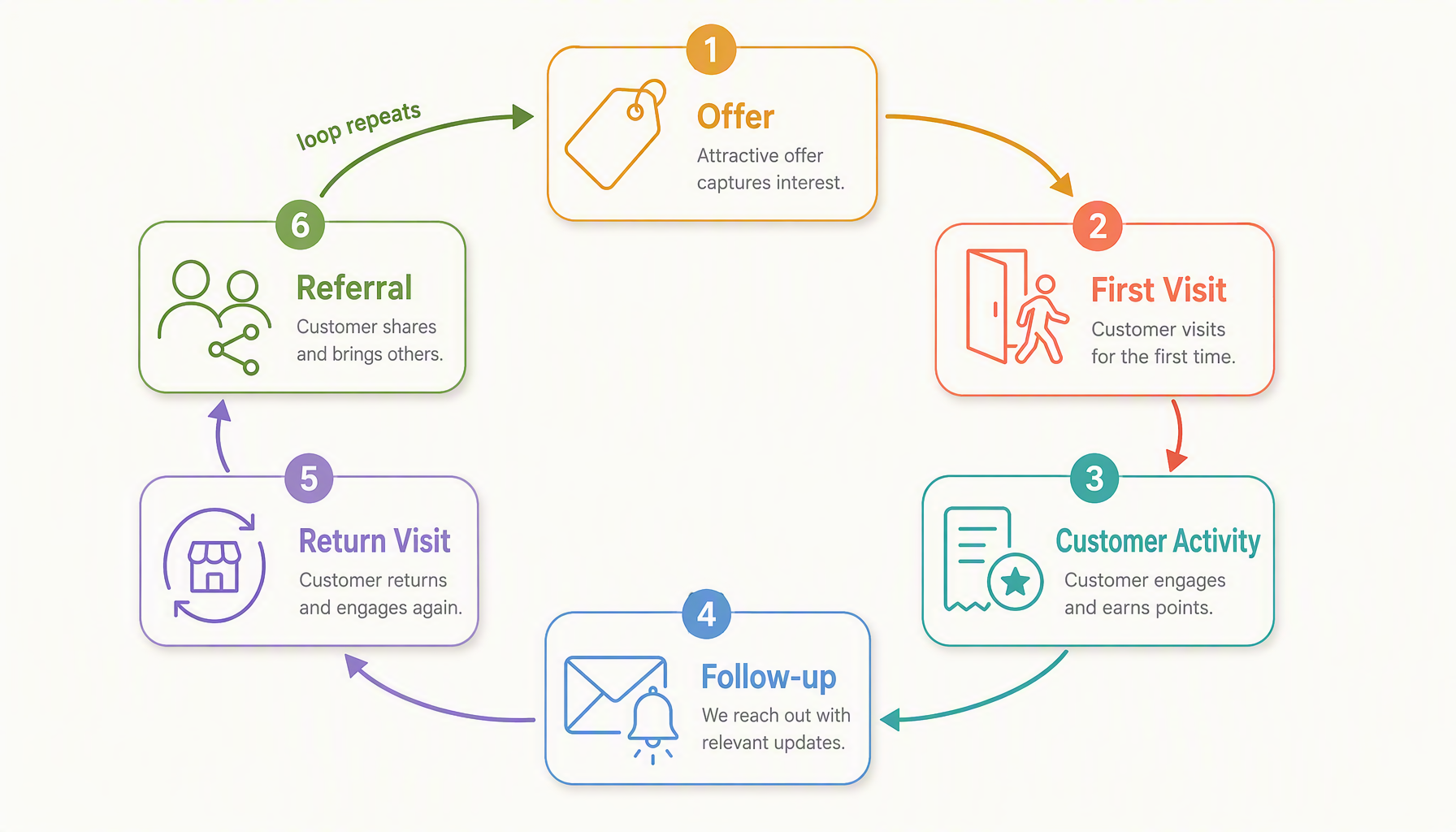
Map the journey from the customer's point of view. They see a post or receive a message. They open the offer, understand its conditions, and decide to visit. At checkout, they show the right screen or identify themselves. A staff member confirms eligibility and applies the benefit. The shop records redemption or purchase activity.
Every handoff can create friction. The message may omit the expiry date. A customer may assume the offer applies to an excluded product. A new employee may not recognize the voucher. Fixing those problems can be more useful than writing another post.
Give staff a short reference with the offer, conditions, redemption steps, and exception route. Test the journey with someone who did not configure it. Ask them to explain what they think the customer receives.
This is also where the distinction between online attention and customer activity matters. A view, click, or offer claim can help you understand interest. A recorded redemption tells you something different. Keep those events separate when reviewing the campaign, and avoid treating them as interchangeable proof of new revenue.
Use customer history to prepare the next campaign
Once a shop records useful activity, the owner can organize customers around specific situations. Examples include a member who has not made a second visit, someone close to a reward, or an active customer who has never referred a friend.
The audience rule should be understandable without a marketing specialist. “Customers who claimed this offer and have not redeemed it” is a clearer starting point than a broad label such as “low engagement.” It also helps you check whether someone should leave the audience after acting.
For each audience, answer four questions: why contact them, what action should they take, what benefit is appropriate, and when should contact stop? A message should respect what the customer has already done. Someone who redeemed this morning should not receive an afternoon reminder to redeem.
Zea brings customer rewards, campaigns, and engagement tools into the same platform. Its Smart Audiences and Autopilot workflows connect recorded loyalty signals to campaign suggestions, with controls for reviewing the offer and message. Available capabilities depend on your plan and setup.
That connection can reduce the work of assembling an audience and starting a campaign. The owner still needs to judge whether the offer fits the shop, whether staff can deliver it, and whether the result warrants another campaign.
Review the whole journey before expanding it
A useful review begins with the original customer action. If the campaign sought second visits, count second visits among eligible customers during the stated period. If it sought referrals, distinguish invitations, new enrollments, and qualifying purchases.
Then review the cost. Include the reward, paid messages where relevant, creative expenses, and the time needed to run the campaign. A high response count may still be unattractive if the offer costs too much or disrupts service.
Recorded activity alone does not tell you how many customers would have acted anyway. A reasonable comparison period or comparable group can help, although small shops often have limited samples. Describe the limits of what you know rather than presenting every redemption as an extra sale.
Use the review to choose the next action. You may improve an unclear offer, adjust the audience, change the timing, or keep the campaign unchanged. You may also decide that customers need a better in-store experience before another message.
Start with one complete journey and make it dependable. Our second-visit campaign guide shows how to turn that approach into a short café campaign. As the records improve, you can add referral and reactivation campaigns without asking staff to learn everything at once.
Questions shop owners ask
Do I need a loyalty program to engage customers?
You can run customer campaigns without one. A loyalty program can provide an ongoing reason to identify customers and record activity, which makes some follow-up campaigns easier to organize.
Does engagement software replace a marketing agency?
It can help an owner perform defined tasks such as organizing audiences and preparing campaigns. Creative direction, strategy, paid-media management, and ongoing agency services are separate responsibilities.
What should I launch first?
Choose a campaign with a clear audience and a customer action you can record. A small, understandable offer-to-visit journey is a useful starting point when you do not yet have much customer history.
Start with one measurable customer journey: a customer joins, receives a useful reason to return, and either returns or does not. Then choose the Zea plan that supports that journey and run it for a defined window before adding another campaign.