

How to Bring Back Regular Customers Without Messaging Everyone
How to Bring Back Regular Customers Without Messaging Everyone
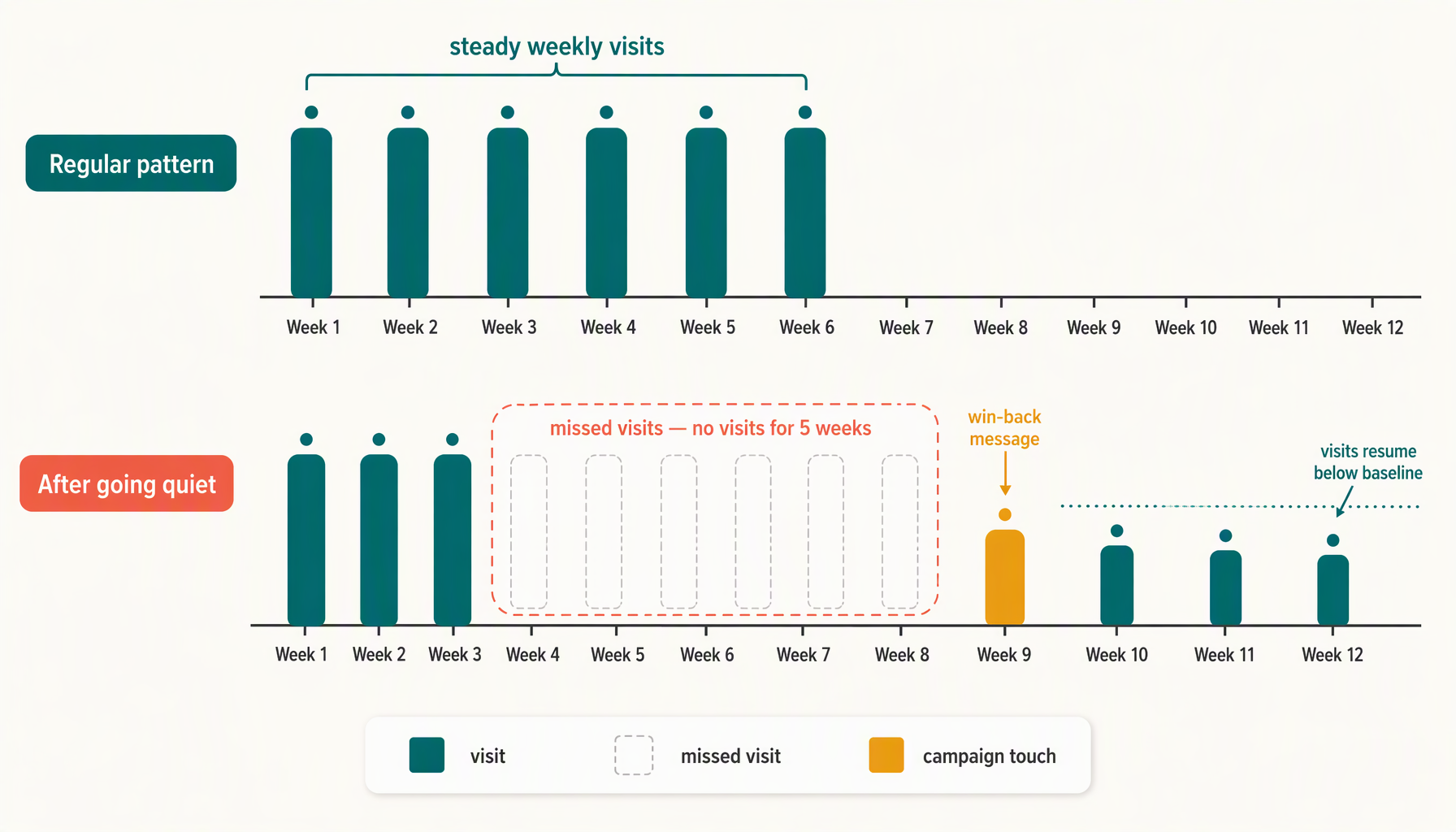
Regular customers rarely announce their departure. They shift to a different café near work, change their schedule, or drift into a new habit. By the time you notice, they may have been away for two months.
You can rebuild some of those relationships. The work is in noticing the change, choosing a suitable reason to return, and contacting the right people at a reasonable rate.
Sending a discount to your whole list does something different. It tells your best current customers that absence is the way to get a better deal, and it spends attention you may want later.
Decide what counts as a regular gone quiet
Start with a definition you can apply to your own records. A regular is usually someone with a pattern: several visits in a typical month, a usual day, or a favorite order. Gone quiet means that pattern stopped.
For a hypothetical café, suppose Maya visited three Fridays out of four for most of the year, then has not appeared in six weeks. That is a recognizable change. A customer who visited twice last year and once this spring is not the same situation, even if both appear inactive on a single report.
Two patterns are worth separating. The first is a recent regular who has missed a few expected visits. The second is a formerly active customer who has been absent for a long time, say two months or more. The first may respond to a light touch. The second may need a stronger reason, or may have genuinely moved on.
Also exclude situations where contact would be unwelcome: opted-out customers, one-time event visitors, and people you have already contacted recently through another campaign. Reaching a lapsed regular twice in one week through different channels feels careless, not attentive.
Choose a reason that fits the history
A returning regular does not need to be introduced to your shop. They already know the counter, the staff, and most of the menu. The message should recognize that history.
Options include a seasonal item they used to order, a modest returning-customer benefit, an invitation to a regulars' event, or simply a warm note when no discount is warranted. Choose based on what you know, and price the benefit using your actual margins before promising it.
Consider what may have changed in their life. A schedule change may mean your Saturday morning offer never reaches them. A new competitor near their office may require a different reason to return than a percentage off. You cannot know every reason, but you can avoid assuming that everyone left because of price.
Set conditions that staff can apply without negotiation: who qualifies, what purchase is required, and when the offer expires. A returning-customer offer that any employee can explain in one sentence will run better than a layered promotion that requires the owner to adjudicate.
Write the message and prepare the counter
Keep the message short and specific to the relationship. Example copy for a hypothetical café:
"Hi Maya, we've missed seeing you on Fridays. Your rewards card is still active, and your usual table has been surprisingly popular. If you'd like a reason to come back this week, we've set aside a small welcome-back treat on your card. No purchase needed to claim it."
Notice what the message does. It references a real pattern, states that the account still works, and describes a concrete benefit with a clear condition. It does not guilt the customer or imply they owe the shop a visit.
Prepare the counter before sending anything. Staff should know the campaign is running, which customers qualify, and how to redeem the benefit. If your POS or loyalty workflow requires a specific step, such as scanning a pass or selecting a reward, test it with a staff account first.
Choose one contact channel and respect the customer's history with it. If they gave you an email for receipts, that may be the appropriate place for one message. If they only interact through the loyalty pass, use the notification style that channel supports. Avoid stacking an email, a text, and a pass notification for the same campaign.
Measure the response honestly
Record four things: customers identified as lapsed regulars, messages sent, returns within the offer window, and reward cost. Then separate the outcome you can count from the outcome you infer.
In an illustrative example, suppose you identify 25 lapsed regulars, contact 18, and see 5 return within three weeks. Five out of 18 is about a 28% observed return proportion for that group. It is not proof that the message caused five visits, and it is not a benchmark for your next campaign. Some may have returned anyway; others may return after the window closes.
A useful supplementary signal is what returning customers do next. If someone comes back once for the free treat and disappears again, the offer answered a different question than the one you intended. Track whether returning regulars resume something like their old pattern over the following month.
Use the review to adjust the definition, not just the discount. Maybe six weeks was too early to define someone as lapsed, or maybe your Friday pattern was seasonal. The audience rule is the part of this campaign you will reuse most.
Zea's Smart Audiences includes use cases for regulars whose pattern has slipped and for previously engaged customers who have gone quiet. As with any automation, review the rule, the timing, and the message before sending, and check which Zea plan includes the capabilities you want.
Once lapsed regulars return, connect them to the next step rather than leaving them idle. Our second-visit campaign guide explains how to structure the return window for newer customers, and the same review habits apply here.
Questions about winning back regulars
How long should someone be gone before I reach out?
Use your own visit pattern as the reference, not a fixed number of days. A useful trigger is missing the visits you would normally expect from that customer, with a minimum window long enough to rule out ordinary schedule changes.
Should win-back offers be bigger than new-customer offers?
Not necessarily. A regular already knows your product. A respectful message and a modest, well-explained benefit often test better than a large discount, which can also train customers to wait for one.
What if they do not respond?
Leave them in peace for a reasonable period. One good message respects the relationship; a sequence of reminders asks the customer to reject you repeatedly. You can include them in general communications they have opted into.
When you can identify the right returning customers and explain the offer at the counter, review Zea's Smart Audience and campaign capabilities before building the first win-back flow.